
10 words to start with
A child's first cards often name food and toys: "juice", "biscuit", "ball". But if the cards only name things, it's hard to say "more", "don't", or "look". A small set of words can be useful in almost any situation. Specialists call this core vocabulary. Here are ten good words to start with.
Core words and topic words
Core words are short and general: "more", "not", "go", "that". According to the American Speech-Language-Hearing Association (ASHA), these high-frequency words make up about 80% of the words most people use every day. That figure comes mostly from English. The words and proportions may differ in other languages, but a small set of frequent words can still be useful in many situations.
Topic words (also called fringe words) name particular things, people and places: "banana", "swing", "grandma". They're needed too, because "want" without "juice" isn't always clear. Core words provide the structure, while topic words add the detail.
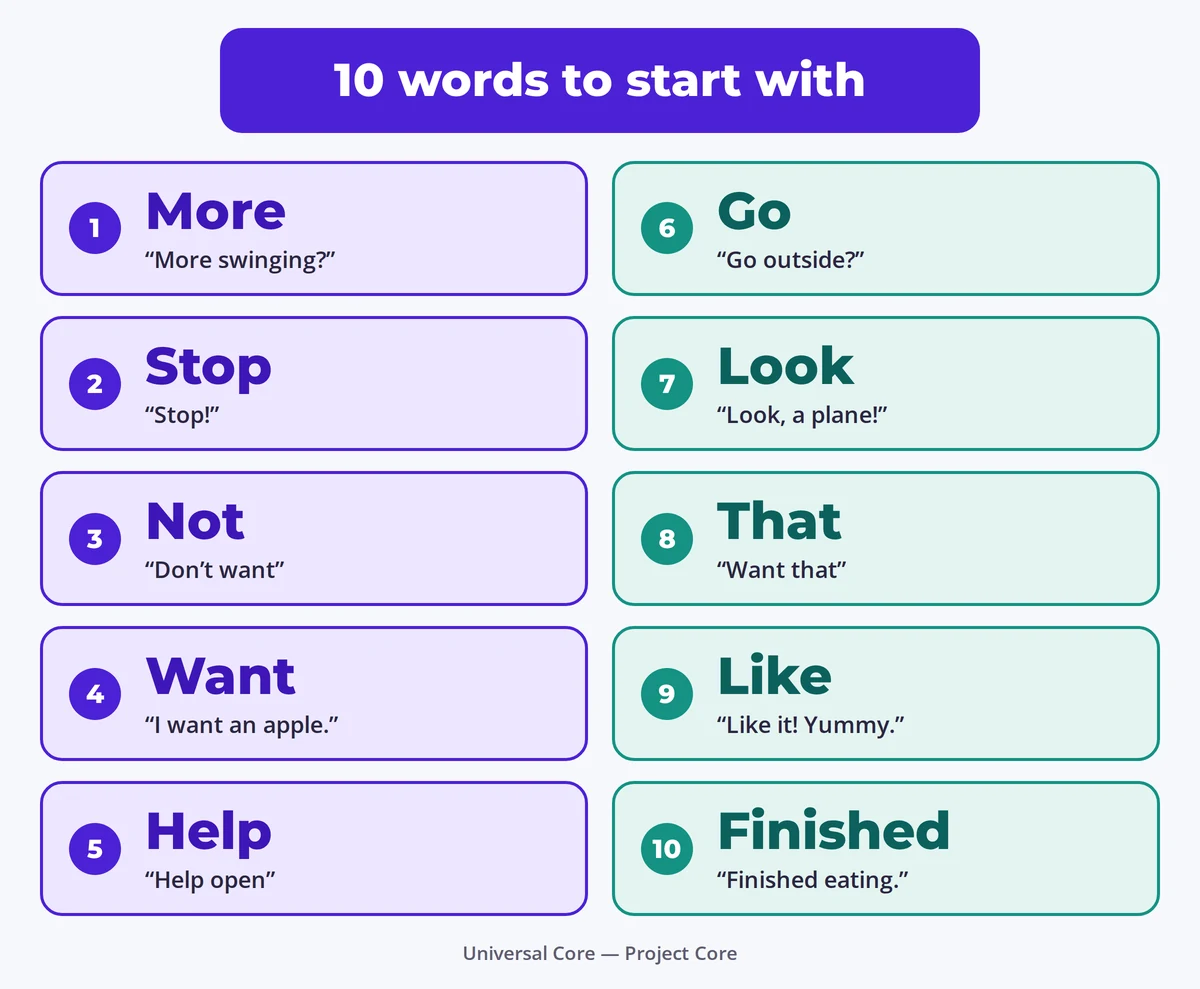
10 words to start with
- More. When your child is enjoying something: "More swinging?" — touch "more", then push again.
- Stop. Use it when you want something to stop: a toy car, music or tickling. Say "Stop!" and freeze.
- Not. For refusing or disagreeing: "Not that", "Don't want". Your child really needs a word for "no".
- Want. Before a choice: "I want an apple." Touch "want" when you talk about your own wishes too.
- Help. When something won't open or won't work: "Help open".
- Go. For walks, games and movement: "Go outside?", "Ready, steady, go!"
- Look. For sharing: "Look, a plane!" This is a word for sharing something, not asking for it.
- That. Together with a pointing finger, it means anything: "Want that", "Not that".
- Like. For saying that something feels good: "Like it! Yummy." Model "don't like" too.
- Finished. To show that something is over: "Finished eating." Your child needs a word to say "that's enough".
All ten are among the 36 words of Project Core's Universal Core set. If you use another language at home, choose words by meaning rather than translating word for word. In languages with lots of word endings, such as Ukrainian, a simple board often shows only one form of each word, and you reply with a full, natural sentence.
Why a word needs a fixed place
When a word stays in the same spot, it's easier to find. If your child chooses by touch, it's also easier to plan the movement towards it. It's like switching on the light at home without having to look for the switch. ASHA explains that words are often kept in place to reduce the demands on memory and motor planning as new ones are added. The AAC system will determine how far this is possible.
- Put these words on the main page of the board and, as far as you can, keep them in the same places.
- Add new words in empty cells. Leave a few cells free for later.
- On the paper copy, keep the words in the same places as on the tablet.
How to start
Project Core advises making all the Universal Core words available to a child while adults model just a few at a time. You don't have to model all ten at once. Pick three or four words a week and use them often in two familiar situations: at meals and during play. Once modelling them feels natural, add the next ones. Our guide "Show it yourself: how to model AAC" explains how.
Questions parents ask
Aren't these words too abstract for a little one?
"More" is hard to draw but easy to show: one more push on the swing, one more piece of apple. The context helps a child learn the meaning, so use the word while the action is happening.
So names of things aren't needed?
They are. Put them in topic folders or on separate boards, with core words on the main page. Our guide "A first communication board in one evening" shows how to make one.
Can I move words around as the board grows?
It's better not to. Your child looks for a word where it usually is. If the board really has to be rearranged, change it as rarely as you can and show your child where the words have moved.
Free ready-made cards. Add the sets Everyday actions, Yes, no and other basic answers and Feedback and clarification to your EYA account and use them in the app — or browse all the free card sets. You can also export any card as a PDF and print it.
Series “AAC: first steps” — part 6 of 8. Previous: A first communication board in one evening. Next: Show it yourself: how to model AAC. All parts.
How EYA helps
- Picture-card board — A grid of picture cards in folders; a tap speaks the card and adds it to a sentence the child can say or send.
- AAC keyboard — Type-to-speech with QWERTY, ABCD and frequency layouts in 6 languages, core words, phrases and word prediction.
- Quick yes / no — Always-on Yes and No buttons for the fastest possible answer.
- Print cards to PDF — Export chosen cards as printable sheets for device-free sessions.