
Your first picture-card communication board in one evening
A communication board is a sheet of pictures or symbols your child chooses from to say something. Unlike single cards, a board shows all its words at once, so your child can put them together: "more juice", "don't want". You can make a first board in one evening. And it really helps if you "talk" on it yourself.
What you'll need
- An A4 sheet or a piece of stiff card.
- Pictures: photos of your own things, symbols, or hand-drawn pictures.
- Glue, scissors and a marker for the labels.
- A laminator, a plastic sleeve or wide clear tape to protect the board from water.
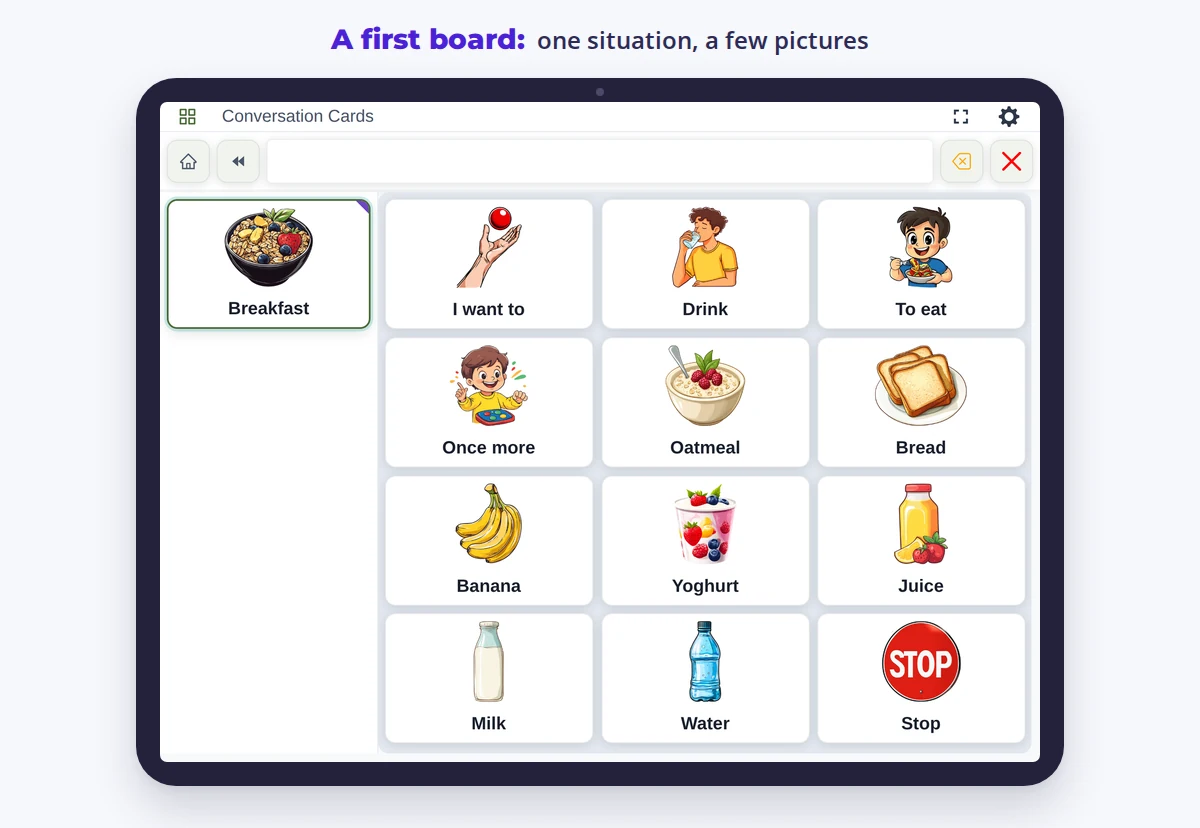
You can also build the board in an AAC app with voice output on a tablet. Touch a picture and the app says the word aloud.
Step by step
- Pick one activity. Something that happens every day and that your child enjoys: breakfast, bubbles, bath time, playing with cars.
- Write down what you say during it. Not only the names of things, but words that work anywhere: "more", "stop", "help", "not", "my turn", "uh-oh".
- Choose 6–12 pictures. Aim for roughly half names of things and half words you can use in different situations.
- Lay them out in rows. Write a short word under each picture. Put words that will be on every board ("more", "stop", "not") in the same spot each time.
- Make it sturdy. Laminate it or slip it into a plastic sleeve.
- Start using it the next day. Use it yourself first, without asking your child to do anything with it.
How many pictures?
There's no right number. For a first board about one activity, 6–12 pictures is often enough — that way each one is easy to see. Some families start straight away with a bigger ready-made board of everyday words. Watch how your child uses the board. If they touch the pictures easily, you can make them smaller and add more. If they often miss them, use fewer, bigger pictures. Our guide "10 words to start with" covers the words worth having on every board.
Where to keep it
Keep it where the activity happens, and make sure both you and your child can reach it. The mealtime board sits on the table, the bath board on the edge of the bath, the play board on the floor next to the game. If your child throws it, tape it to the table. Don't put it away in a cupboard "until therapy". The board is for the moments when your child has something to say.
How to "talk" on it
Talk as you normally would, touching one or two key words as you go. Say "Oh, it popped! More?" and touch "more". Then wait a few seconds. If your child touches any picture, say the word and respond as if they'd said it out loud. There's more in "Show it yourself: how to model AAC".
Questions parents ask
Photos or symbols?
Children often recognise photos of their own things faster. Symbols are handier for words you can't photograph: "more", "not", "stop", "help". One board can have both.
Paper or tablet?
Both. A laminated board can get wet, and paper never needs batteries. A tablet speaks the words aloud and holds many boards. It's good to keep a paper copy of your main board just in case.
My child won't look at the board. What now?
Keep showing it yourself, with no demands. Check that the board is about something your child really cares about and that it's easy to reach. Your child needs to see others use it many times.
When should I make a second board?
When you're using the first board every day, pick the next activity and put the shared words in the same places as before.
Free ready-made cards. Add the sets Making requests and asking for help, Basic needs and Everyday actions to your EYA account and use them in the app — or browse all the free card sets. You can also export any card as a PDF and print it.
Series “AAC: first steps” — part 5 of 8. Previous: How a child picks a picture: touch, switch, eye gaze. Next: 10 words to start with. All parts.
How EYA helps
- Picture-card board — A grid of picture cards in folders; a tap speaks the card and adds it to a sentence the child can say or send.
- Talk Board canvas — A free canvas of cards and stickers with background and grid; a board library, duplicate and PDF export.
- Your own cards — Label, photo, recorded voice, sound or video; bulk edit, duplicate, and a trash with restore.
References
- Communication Boards — Children's Speech and Language Therapy Service, Leicestershire Partnership NHS Trust
- Using Aided Language Boards to help your child communicate — NHS Lothian Speech and Language Therapy
- Using Aided Language to Develop Skills with Augmentative Communication Displays — Indiana Resource Center for Autism, Indiana University
- Augmentative and Alternative Communication — ASHA Practice Portal