
What is AAC? Augmentative and alternative communication
Does your child not speak yet, or use only a few words? You probably spend a lot of time guessing why they're crying, what they want or what they're trying to tell you. It wears you both out. AAC gives your child a way to "say" things now, without waiting for the words to come.
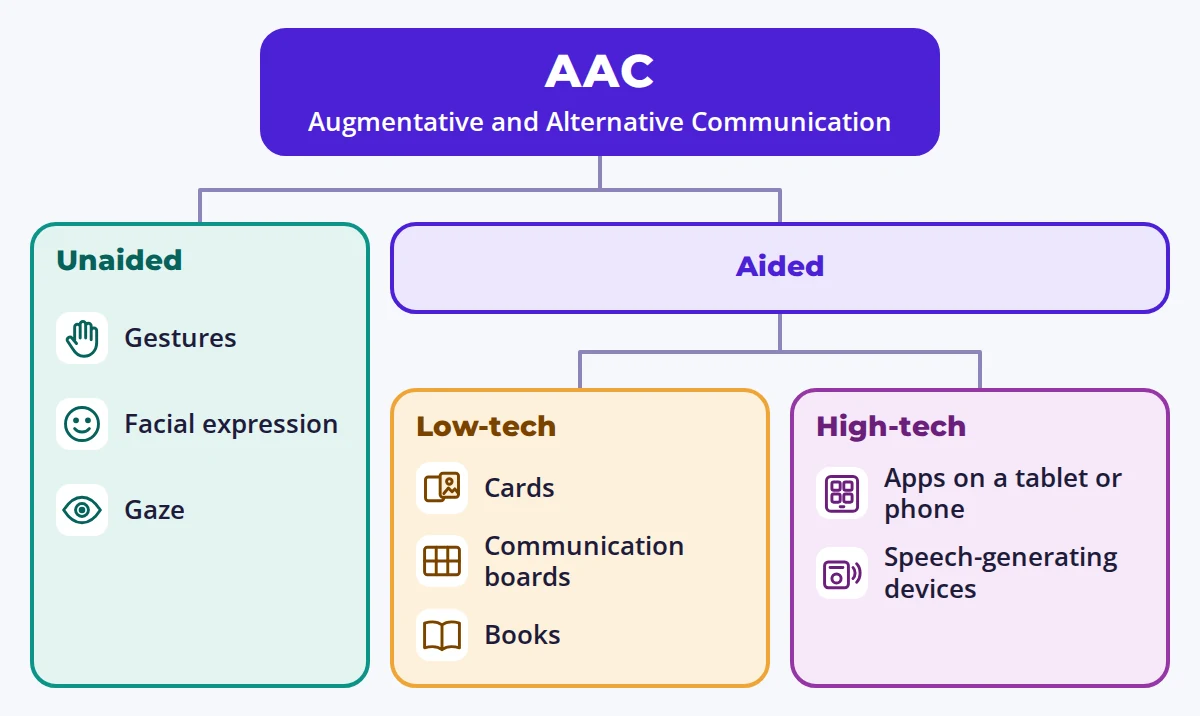
AAC stands for augmentative and alternative communication. Put simply, it's anything that helps someone communicate when speech isn't enough: gestures, picture cards, communication boards or an app on a tablet. AAC doesn't take anything away from your child. It simply gives them another way to be understood, which can be adapted to their needs.
- Augmentative means it adds to, rather than replaces, the ways your child already communicates: words, sounds, gestures.
- Alternative means it uses ways of communicating other than speech, such as pictures, signs or an app.
Who is AAC for?
AAC is for anyone who finds it hard to communicate day to day using speech: children with autism, cerebral palsy, Down syndrome or other conditions, or children with delayed or severe speech difficulties. Some don't speak at all. For others, words "disappear" when they're anxious, or only Mum can understand them.
The series: parts 2–8
Read them in order — each part answers one question and takes a few minutes.
2. Will AAC stop my child from talking?
This is the fear parents mention most often. This part looks at what research shows and what to say to relatives who tell you "just wait, he'll talk". Read more →
3. Signs, cards, tablets: the kinds of AAC
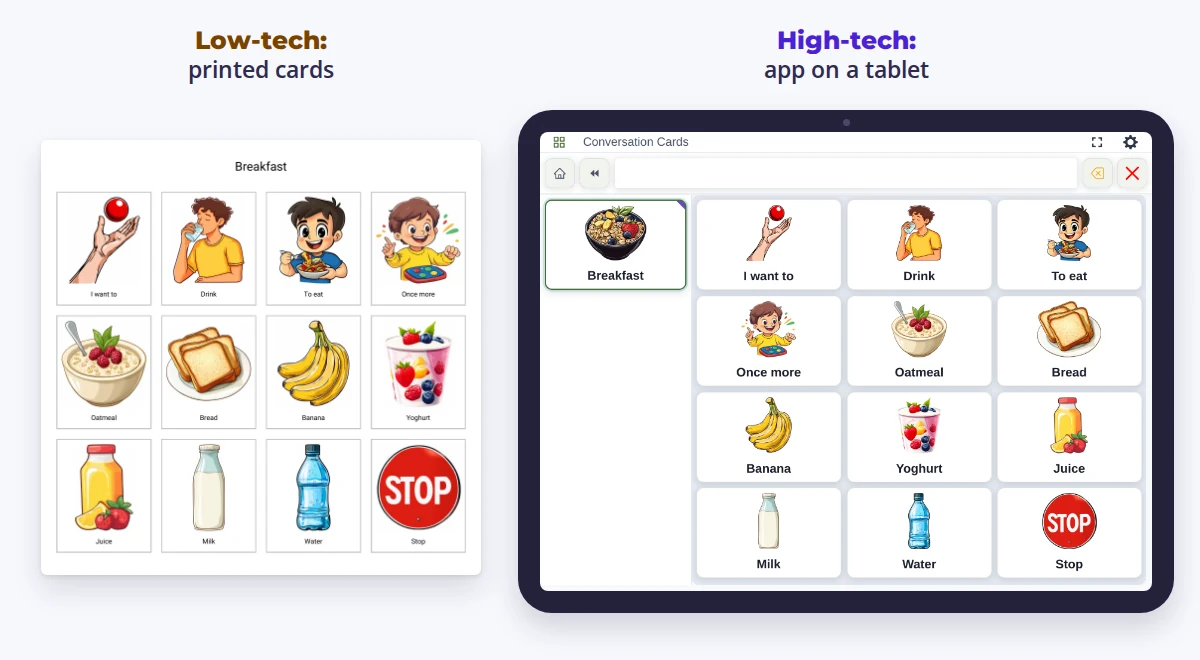
This part covers AAC with and without objects, paper and digital tools, what PECS and Makaton are, and how to decide where to start. Read more →
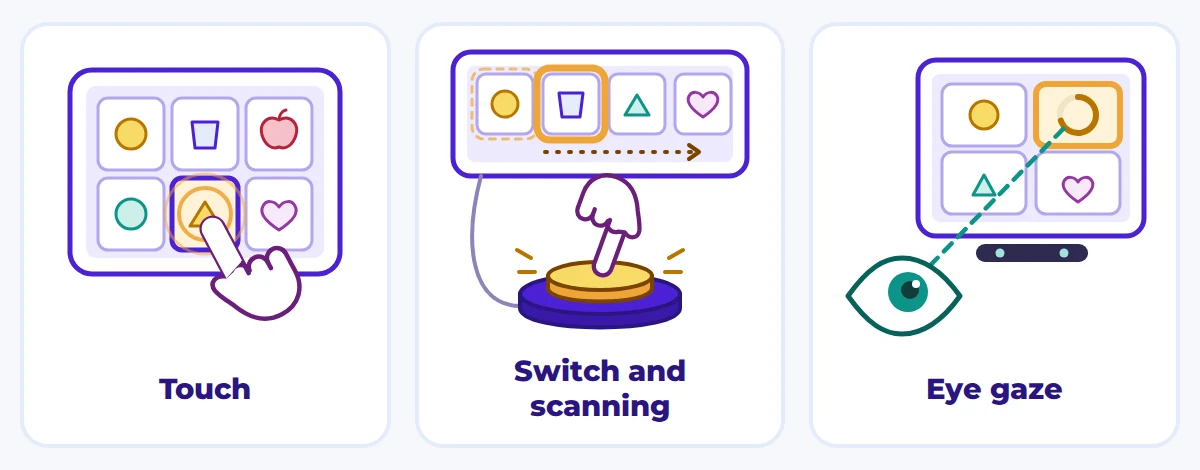
4. How a child picks a picture: touch, switch, eye gaze
Not every child can point accurately with a finger. This part looks at other ways to choose and when to ask a specialist which approach may suit your child. Read more →
EYA does not offer Eye-gaze selection.
5. A first communication board in one evening
What you'll need, how many pictures to use, how to lay them out and where to keep the board. Read more →
6. 10 words to start with
"More", "stop", "not", "want" and other words can be used in almost any situation. This part also explains why each one needs a fixed place. Read more →
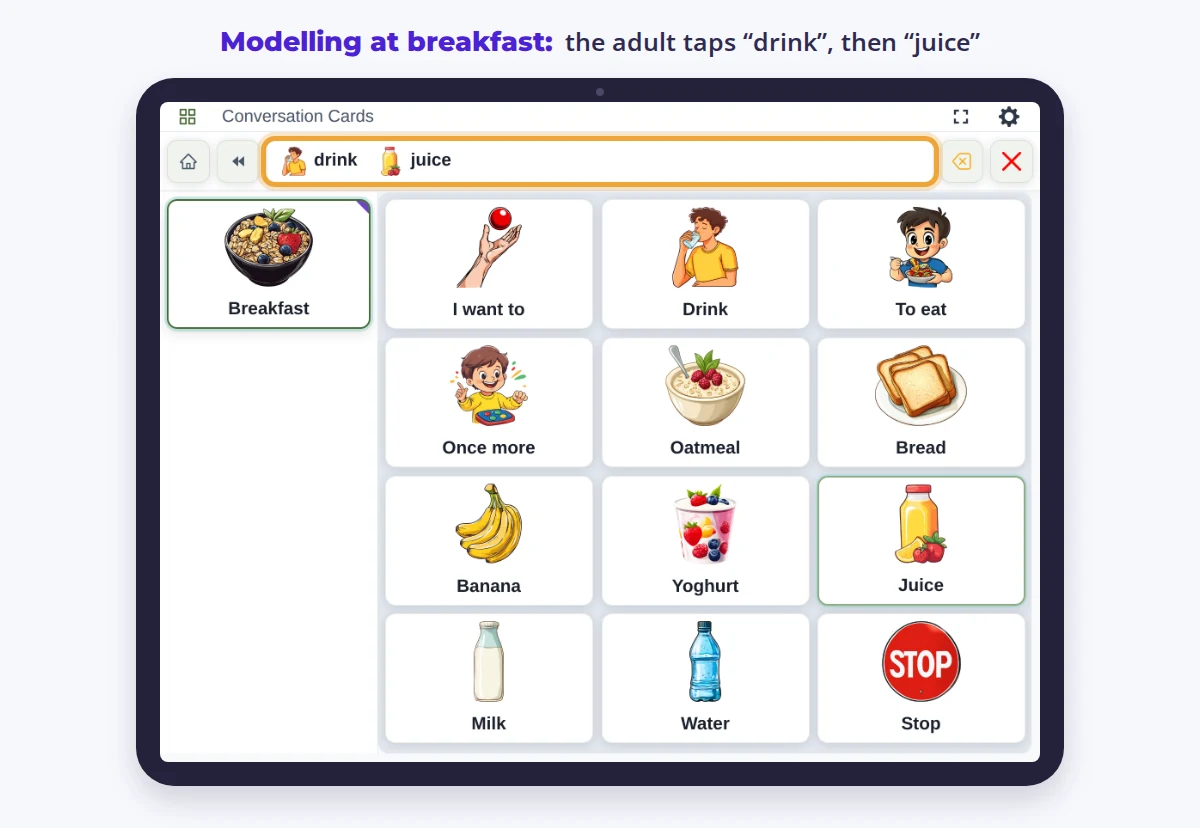
7. Show it yourself: how to model AAC
Talk as usual and touch the picture. This part gives you four simple steps, three everyday examples and some mistakes to avoid. Read more →
8. More than asking: saying no, commenting, asking questions
Requests are only one part of communication. This part looks at how to give your child words to refuse, share, ask and say how they feel. Read more →
Where to get help in Ukraine
You can find help and support through:
- a speech therapist who works with AAC;
- your local inclusive resource centre (ІРЦ);
- an early intervention service — for the youngest children;
- rehabilitation centres and assistive technology centres.
Questions parents ask
Do I need an expensive device to start?
No. You can start with a printed board or a low-cost or free app. If a dedicated device turns out to be needed, it's best to choose it together with a specialist.
Can we mix gestures, cards and a tablet?
Yes. Many families use different methods in different situations: gestures while playing, a laminated board in the bath or in the playground, and the app during therapy and at home.
Free ready-made cards. Browse the free card sets in the EYA store, add them to your EYA account and use them in the app. You can also export any card as a PDF and print it.
How EYA helps
- Picture-card board — A grid of picture cards in folders; a tap speaks the card and adds it to a sentence the child can say or send.
- Your own cards — Label, photo, recorded voice, sound or video; bulk edit, duplicate, and a trash with restore.
- AAC keyboard — Type-to-speech with QWERTY, ABCD and frequency layouts in 6 languages, core words, phrases and word prediction.
- Print cards to PDF — Export chosen cards as printable sheets for device-free sessions.
References
- About AAC — ISAAC (International Society for Augmentative and Alternative Communication)
- Augmentative and Alternative Communication — ASHA Practice Portal
- Augmentative and Alternative Communication (AAC) — Helping You Communicate (CHSA, powered by ASHA)
- What is AAC? — Communication Matters (UK AAC charity)
- Millar, Light & Schlosser (2006). The impact of AAC intervention on the speech production of individuals with developmental disabilities: a research review. J Speech Lang Hear Res 49(2):248–264
- Romski & Sevcik (2005). Augmentative communication and early intervention: myths and realities. Infants & Young Children 18(3):174–185
- Light & McNaughton (2012). Supporting the communication, language, and literacy development of children with complex communication needs. Assistive Technology, 24(1), 34–44
- Kasari et al. (2014). Communication interventions for minimally verbal children with autism: a sequential multiple assignment randomized trial. JAACAP, 53(6), 635–646
- Drager, Light & McNaughton (2010). Effects of AAC interventions on communication and language for young children with complex communication needs. J. Pediatric Rehabilitation Medicine, 3(4), 303–310