
Show it yourself: how to model AAC
Children learn to talk because they hear other people talk for years. A child who uses AAC also needs to see the adults around them use their "language". So the most important thing you can do is talk on your child's board or tablet yourself. Specialists call this modelling.
What modelling is
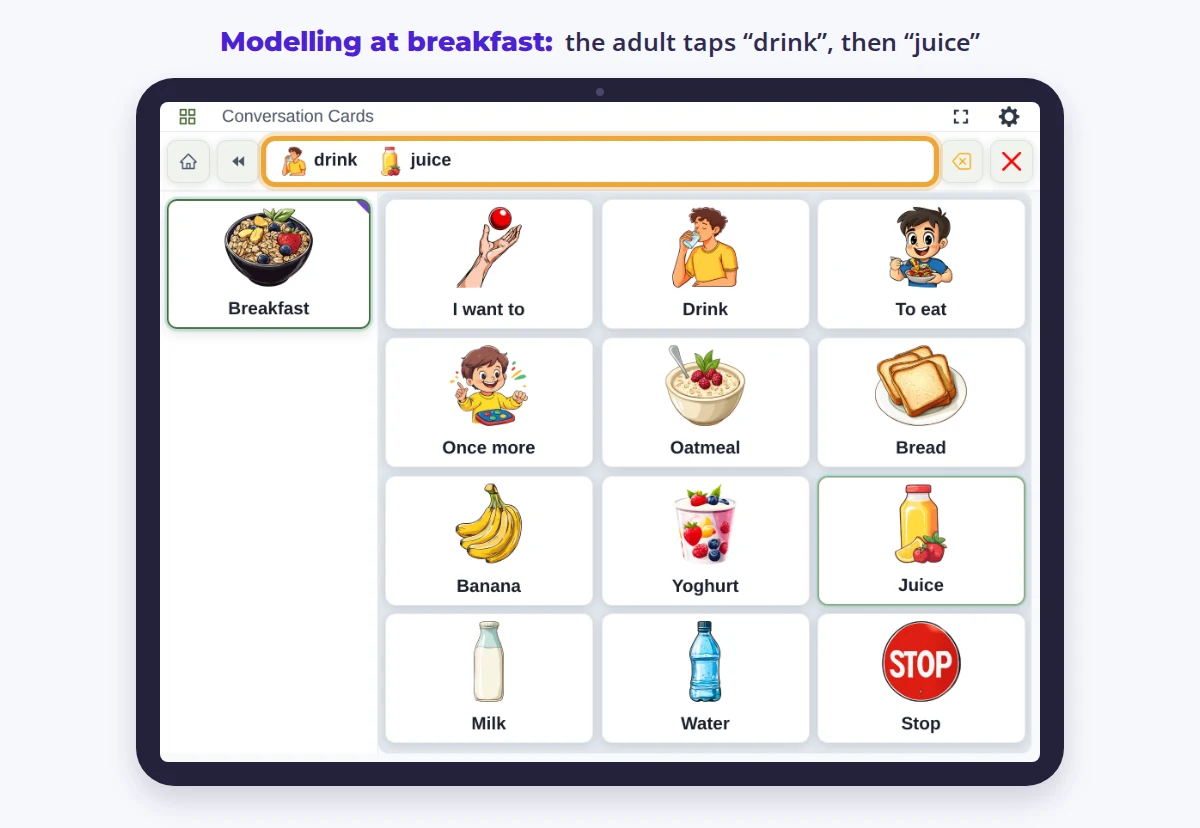
You talk to your child as usual and, at the same time, touch pictures on their board or tablet. Not every word — just one or two key ones. Your child hears the word and sees where it "lives" and how it's used.
You don't ask for an answer. You simply show how it's done — the same way we talk to a baby long before they talk back. Research reviews found that programmes which included this kind of modelling helped children in different ways: taking more turns in conversation, understanding and using more words, putting words together. That doesn't mean every child will get all of this, or that modelling alone did it.
Four steps
- Keep the board close. Where both you and your child can reach it.
- Talk and touch. Say an ordinary sentence and touch one or two key words: "Uh-oh, it fell!" — touch "uh-oh".
- Wait. Stay quiet for a few seconds and look at your child with interest. This pause is their turn to answer — with a word, a sound, a gesture or a touch.
- Respond to everything. Did your child touch a picture, even by accident? Say the word and respond as if they meant it. You can add one word: they say "more", you say "more juice".
Three everyday scenes
Breakfast
"I want porridge" — touch "want". "More? More milk" — "more". "Ooh, hot!" — "uh-oh". "All done" — "finished".
Bath time
"Nice warm water, I like it!" — "like". "Stop, soap in your eyes" — "stop". "Look, the duck's swimming" — "look". "More splashing?" — "more".
A walk
Take a paper board or your phone with you. "Let's go out" — "go". "Look, a dog!" — "look". "Where's the ball? There it is" — "where". "Tired? Home time" — "home".
Common mistakes
- Testing. "Show me 'drink'" or "Say 'more'" turns a conversation into an exam. Just talk and point.
- Giving things only "for the right card". If your child touches a different card, respond to what they "said", and show the word you expected yourself.
- Modelling only requests. Show "uh-oh", "funny", "don't like" and "look" too. Our guide "More than asking" is all about this.
- Putting the board away. If it's in a cupboard, there's nothing to model on.
- Expecting quick results. Your child needs to see a word many times before trying it.
If your child ignores it
That can happen at first. If your child keeps ignoring the cards, check with a specialist whether the symbols, layout, words and way of choosing suit them. Your child might watch from the side or play next to you — they don't have to look straight at the board to notice something. Even if they turn away, they can still hear you. Beginners often need to watch several times before they try it themselves. Keep modelling without demands, briefly and often. Check that the board is about something your child really cares about. And don't take it away, even if it seems "not to be working".
Questions parents ask
How many times a day should I model?
As often as feels natural. Short and frequent — at meals, in the bath, in play — is better than one long "lesson".
Do I have to show every word in the sentence?
No. One or two key words are enough. If the board is still small, show the words that are on it. Our guide "10 words to start with" covers the words worth having on every board.
I don't always know where a word is on the board. Is that bad?
No. Search out loud: "Where's 'more'? Here it is!" That shows your child that looking for a word is fine.
Who should model?
Everyone around your child: parents, brothers and sisters, grandparents, teachers. The more people "talk" on the board, the more often your child sees that it's really used.
Series “AAC: first steps” — part 7 of 8. Previous: 10 words to start with. Next: More than asking: saying no, commenting, asking questions. All parts.
How EYA helps
- Picture-card board — A grid of picture cards in folders; a tap speaks the card and adds it to a sentence the child can say or send.
- Print cards to PDF — Export chosen cards as printable sheets for device-free sessions.
- Your own cards — Label, photo, recorded voice, sound or video; bulk edit, duplicate, and a trash with restore.
References
- Augmentative and Alternative Communication — ASHA Practice Portal
- Sennott, Light & McNaughton (2016). AAC modeling intervention research review. Research and Practice for Persons with Severe Disabilities 41(2):101–115
- Biggs, Carter & Gilson (2018). Systematic review of interventions involving aided AAC modeling for children with complex communication needs. Am J Intellect Dev Disabil 123(5):443–473
- Using Aided Language Boards to help your child communicate — NHS Lothian Speech and Language Therapy
- Communication Boards — Children's Speech and Language Therapy Service, Leicestershire Partnership NHS Trust
- Using Aided Language to Develop Skills with Augmentative Communication Displays — Indiana Resource Center for Autism, Indiana University