
AAC at the doctor: getting your child and board ready
A visit to the doctor can mean a new place, unfamiliar people and questions your child is expected to answer. To make it easier for them to answer for themselves, you can prepare three things: a short board for the visit, a one-page "about me" note on how they communicate, and a few sentences for the staff.
A short board for the visit
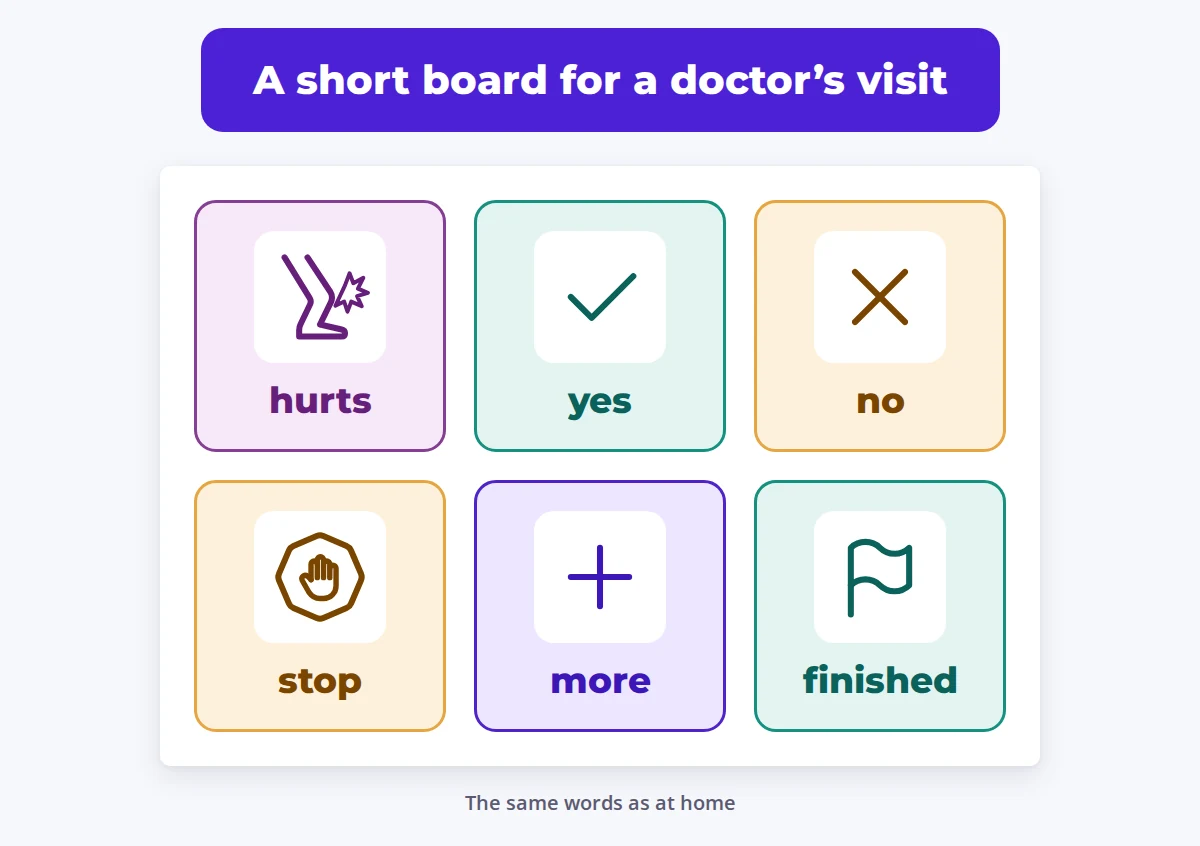
For people who use AAC in hospital, specialists stress words that let them take part in their own care: saying what they need, and saying no. The same words are useful at an ordinary appointment. Put together a small board — a separate sheet, or a separate folder on the device:
- "hurts" and a few body parts: head, tummy, ear, throat, arm, leg;
- "yes" and "no";
- "stop", "wait", "more", "finished";
- "scared", "drink", "toilet", "mum" or "dad".
If these words are already on the main board, check that your child knows where they are. If you can, bring a charged tablet and a paper copy as a backup.
In EYA you can choose the cards you need and save them as a PDF to print.
Practise at home
Before the visit, you could play doctors if that kind of preparation suits your child. Teddy "says" "hurts" and "ear" on the board, you show "stop" when the toy doctor rushes, and "finished" when the check-up is over. Your child sees the words in action — the same modelling described in "Show it yourself".
Where possible, show your child that you notice and respond to "stop" and "no"; if something cannot stop, explain what is happening. Our guide "More than asking" explains why. At the doctor's not every procedure can be stopped, but you can ask for a short pause and an explanation of what comes next.
An "about me" page
Some children's hospitals provide communication and health passports that families can complete and bring to appointments. For an appointment, you can make a shorter page specifically about communication; it does not replace medical information. Where possible, write it in your child's voice:
- I communicate with: … (board, tablet, gestures, sounds). My board is kept: …
- I show "yes" like this: … and "no" like this: … If you're not sure, write what you usually notice.
- When I'm in pain or scared, you might notice: …
- It helps when you talk to me, ask one question at a time and wait for my answer.
- I find it hard when: … (loud noises, being touched without warning, and so on).
What to tell the staff
When you arrive, hand over the page and say a few sentences: "My child communicates with a board. Please talk to them directly, ask one question at a time and give them time to answer." If you book ahead, you can mention it when you make the appointment.
Questions parents ask
What if my child answers "yes" to everything?
Some children do. Do not rely only on a yes/no answer or a choice between two options. Tell the doctor how your child usually answers, and work together to check the response in a way that is familiar to your child. If you're unsure about an answer, tell the doctor.
Should I bring the tablet or paper?
Both, if you can. Paper helps when the tablet is awkward to hold or has run flat.
Can I answer for my child?
You can help and explain. But when a question is for your child, let them try first, then add what you know.
Should I put a diagnosis on the page?
That's up to you. This page is about communication. Share medical details with the doctor the way you usually do.
Series “AAC: first steps” — see also: all parts.
How EYA helps
- Picture-card board — A grid of picture cards in folders; a tap speaks the card and adds it to a sentence the child can say or send.
- Print cards to PDF — Export chosen cards as printable sheets for device-free sessions.