
More than asking: saying no, commenting, asking questions
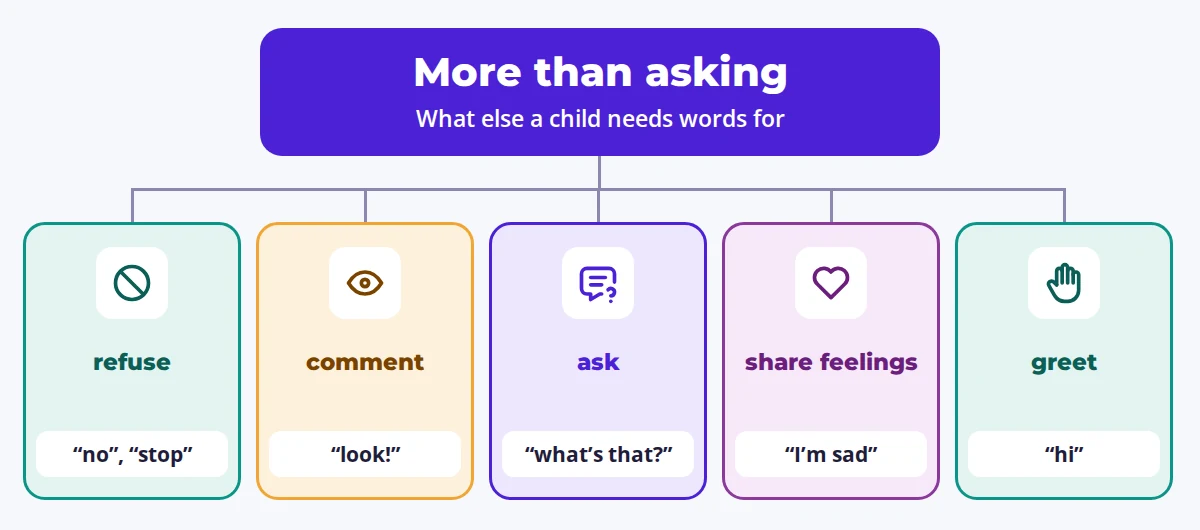
Children who use AAC are usually taught to ask first: for food, a drink, a toy. That matters. But communication is so much more. We say no, share things, ask questions, joke, say what hurts. Your child needs words for all of that too.
Researchers see this imbalance too: most studies on teaching AAC focus on requests. Yet comments, as the authors of a 2025 review put it, are what a child needs to join in with others, grow close to them and share new things.
Saying no
"No" is one of the most important words there is. Without a way to say it that others understand, some children refuse by screaming, throwing things or running away; others use looks, gestures or turning away. Words for it: "no", "not", "don't want", "finished", "stop".
- Model "no" about yourself: "No, I don't want tea. Not that."
- When your child says "no", respect it when you can: "Don't want it? OK, we won't."
- If you can't go along with the no, still acknowledge it: "You're saying no. I understand. Coat first, then the swings."
Sharing and commenting
A comment is "look, a dog!" or "uh-oh, it fell". Your child isn't asking for anything — just sharing. Words: "look", "uh-oh", "that", "big", "funny", "like".
Reading a book together or going for a walk gives you plenty of chances to comment: "Look, a cat. A big cat!" Don't wait for an answer — you're just sharing too.
Asking questions
We ask children questions all the time but rarely teach them to ask their own. Words: "what?", "where?", "who?", "where to?".
- Bring a toy in a closed box and ask out loud, touching "what": "What's in there?"
- Hide the ball and ask: "Where's the ball?"
- When the doorbell rings: "Who's that?"
Talking about feelings
Your child needs to be able to say "it hurts", "scared", "sad", "happy", "tired". Model these words in real moments when they fit: "Ouch, you bumped it. It hurts." Name your own too: "I'm tired. I'll sit down."
Being with other people
"Hi", "bye", "thank you", "my turn", "your turn", a joke or a favourite silly word. These help your child be part of the game and the conversation, not only get what they need. Short ready-made phrases — "Hi, how are you?" — are handy to keep on the board or in the app, so they can be said with a single touch.
How to add these words
- Add one or two words at a time. For example, "no" and "look".
- Give them a fixed place. So your child can find them without searching.
- Model them in everyday moments. Not in a "lesson", but at meals, in the bath, on walks. Our guide "Show it yourself: how to model AAC" explains how.
- Respond to any new word. Even if your child touched it by accident.
Many of these are core words: they come in handy in lots of situations. There's more about them in "10 words to start with".
Questions parents ask
What if my child starts saying "no" to everything?
It happens: your child is checking whether the new word works. Respect "no" where you can. Where you can't, acknowledge it and explain what happens next.
My child is only just learning to ask. Isn't it too early for "no" and "look"?
No. Requests matter, but the other words don't need to wait. Show them alongside, in the same everyday moments: at breakfast you can ask for "more", say "don't want" and share "ooh, hot". Your child will pick what they need to say right then.
How should I answer a comment?
Like in any conversation: "Yes, a dog! A big one. Woof!" Don't turn the comment into a request by asking "Do you want the dog?"
Where do I get pictures for feelings?
Symbols of faces work, and so do photos of your child and family making different faces. What matters is that your child recognises what's in them.
Series “AAC: first steps” — part 8 of 8. Previous: Show it yourself: how to model AAC. All parts.
How EYA helps
- Picture-card board — A grid of picture cards in folders; a tap speaks the card and adds it to a sentence the child can say or send.
- Quick yes / no — Always-on Yes and No buttons for the fastest possible answer.
- Talk (saved phrases) — Ready phrases grouped by topic; the child speaks one or all with a single tap.
- Send the sentence to family — The child sends the sentence they built to their own contacts (Telegram, push).
References
- Augmentative and Alternative Communication — ASHA Practice Portal
- Spencer, Tönsing & Dada (2025). Augmentative and alternative communication (AAC) interventions that promote commenting: a systematic review. Augment Altern Commun 42(3):285–298
- Building AAC Awareness: Using AAC to Express a Range of Functions — PrAACtical AAC (Carole Zangari, 2018)
- Using Aided Language Boards to help your child communicate — NHS Lothian Speech and Language Therapy