
Will AAC stop my child from talking?
You want so much for your child to talk. And you're afraid that if you give them picture cards or a tablet, they'll get used to them and stop trying to speak. This is probably the most common fear parents have. The short answer: research doesn't back it up. Studies haven't found that using AAC makes children talk less.
Where the fear comes from
It makes sense: with an "easier way" on offer, why would a child make the effort? Friends and relatives often add to it: "Don't rush into cards — just wait, he'll talk." But waiting on its own doesn't give a child a reliable extra way to communicate. AAC can help them be understood right now.
What the research shows
Here are the studies specialists rely on most.
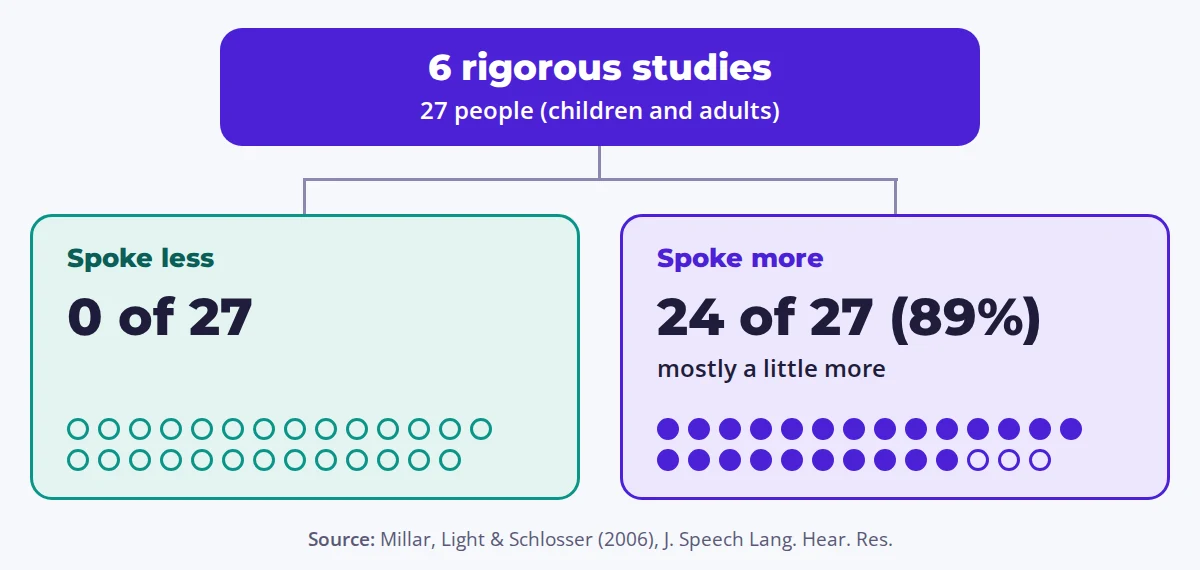
- A 2006 review. Millar, Light and Schlosser gathered studies on how AAC affects speech. The six most rigorous ones covered 27 people, children and adults. None of them started speaking less. Twenty-four (89%) spoke more, although for most of them the gains were modest.
- A 2014 study. Connie Kasari's team worked with 61 autistic children aged 5 to 8 who spoke very little. All the children had play-based sessions with adults; some also had, from the very start, a device that speaks words aloud — for example, a tablet. Those children started talking on their own more often and used more new words. Over 90% of what they said was spoken with their own voice, not by the device.
- A 2012 review. Janice Light and David McNaughton concluded that children gain a great deal from AAC for communication, language and literacy — "with no risk to their speech development".
- A 2005 paper. MaryAnn Romski and Rose Sevcik took apart common myths about AAC. On the fear that AAC will stop speech, they're direct: the available data don't support it.
To be fair: AAC doesn't promise that your child will talk. It gives them a way to communicate now, without taking away their chance of words.
Why this might be
When a child touches a picture and you say the word — or the device says it — they hear the word once more. The authors of the 2014 study suggest that all this repetition may have helped. And when a child is better understood, they may get less frustrated and be keener to keep trying to communicate. Studies don't show AAC holding speech back: if saying a word is easier for a child, they can choose the word.
What to say when people tell you "just wait, he'll talk"
- Explain that AAC means "and", not "instead". Your child still uses sounds and words; the cards or tablet help when the words aren't there.
- Say what you're basing it on. "Studies haven't found that AAC gets in the way of speech." The references are at the bottom of this page.
- Show them how it works. Often a grandparent or teacher just needs to see your child touch "more" — and get more. Ask them to talk and point to the pictures too. Our guide "Show it yourself: how to model AAC" explains how.
- Ask them not to take the board or tablet away. Not "for bad behaviour", and not "so he'll talk instead". It's your child's voice, not a toy.
- Bring in a specialist. A speech and language therapist who works with AAC can explain this to teachers and family — sometimes it lands better from a professional.
Questions parents ask
My child already says a few words. Do they need AAC?
They might. That's exactly what augmentative communication is for: helping a child say more than their words allow, and be understood outside the family too. Our guide "Signs, cards, tablets: the kinds of AAC" explains the options.
Won't my child get "lazy" about talking?
Studies haven't seen that. Many children keep using words when the words are there for them; others choose a card, a device, a sign — or a mix of these.
When is the best time to start?
There's no need to wait until your child is "old enough". Romski and Sevcik list the idea that a child has to reach a certain age before AAC as one of the myths. You can start with one everyday moment at home.
What if speech never comes?
Then your child will already have a way to communicate. AAC isn't a "last resort" — it's their voice today.
Series “AAC: first steps” — part 2 of 8. Previous: What is AAC? Next: Signs, cards, tablets: the kinds of AAC. All parts.
How EYA helps
- Picture-card board — A grid of picture cards in folders; a tap speaks the card and adds it to a sentence the child can say or send.
- Free device voice — Speech with the phone or tablet's built-in voice — free.
References
- Millar, Light & Schlosser (2006). The impact of augmentative and alternative communication intervention on the speech production of individuals with developmental disabilities: a research review.…
- Kasari et al. (2014). Communication interventions for minimally verbal children with autism: a sequential multiple assignment randomized trial. J Am Acad Child Adolesc Psychiatry 53(6):635–646
- Light & McNaughton (2012). Supporting the communication, language, and literacy development of children with complex communication needs: state of the science and future research priorities.…
- Romski & Sevcik (2005). Augmentative communication and early intervention: myths and realities. Infants & Young Children 18(3):174–185
- About AAC — ISAAC (International Society for Augmentative and Alternative Communication)
- Communication Boards — Children's Speech and Language Therapy Service, Leicestershire Partnership NHS Trust