
Signs, cards, tablets: the kinds of AAC
AAC isn't one thing — it's a whole set of ways to communicate. Some need nothing but hands and a face. Some need a sheet of paper. Others need a tablet with an app. Let's sort out which is which, and how to choose where your family starts.
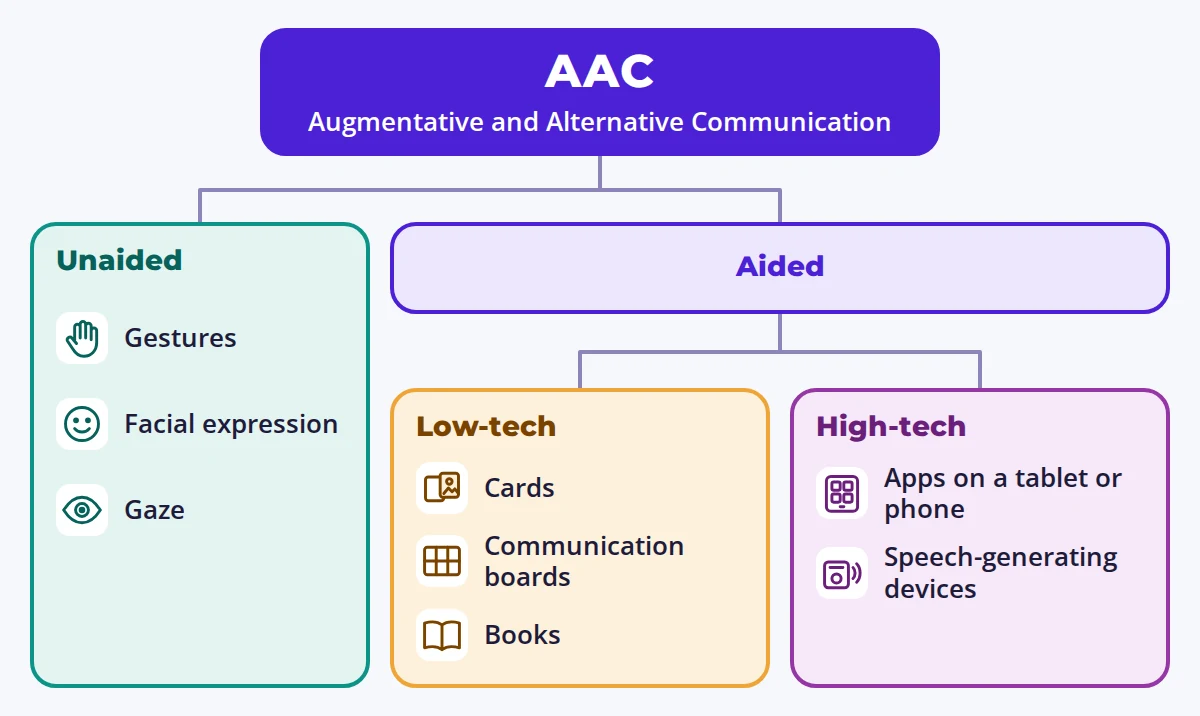
Without any objects: gestures, faces, looking
Specialists call this "unaided AAC". A child communicates with their body: pointing, nodding, leading you by the hand, looking at what they want, making gestures. It's always with them — in the bath, in the car, at night.
There are also signing systems built for this. One of them is Makaton, which brings together speech, signs and picture symbols. The signs are made along with speech, in the same order as the spoken words. Your family can also agree on a few simple gestures of your own — "more", "finished", "drink". What matters is that every adult makes them the same way. A national sign language, such as British or Ukrainian Sign Language, is something different: a full language of the Deaf community.
The downside of gestures is that not everyone understands them, and they need fairly precise hand movements.
With objects: from a card to a tablet
This is "aided AAC". There are two big groups.
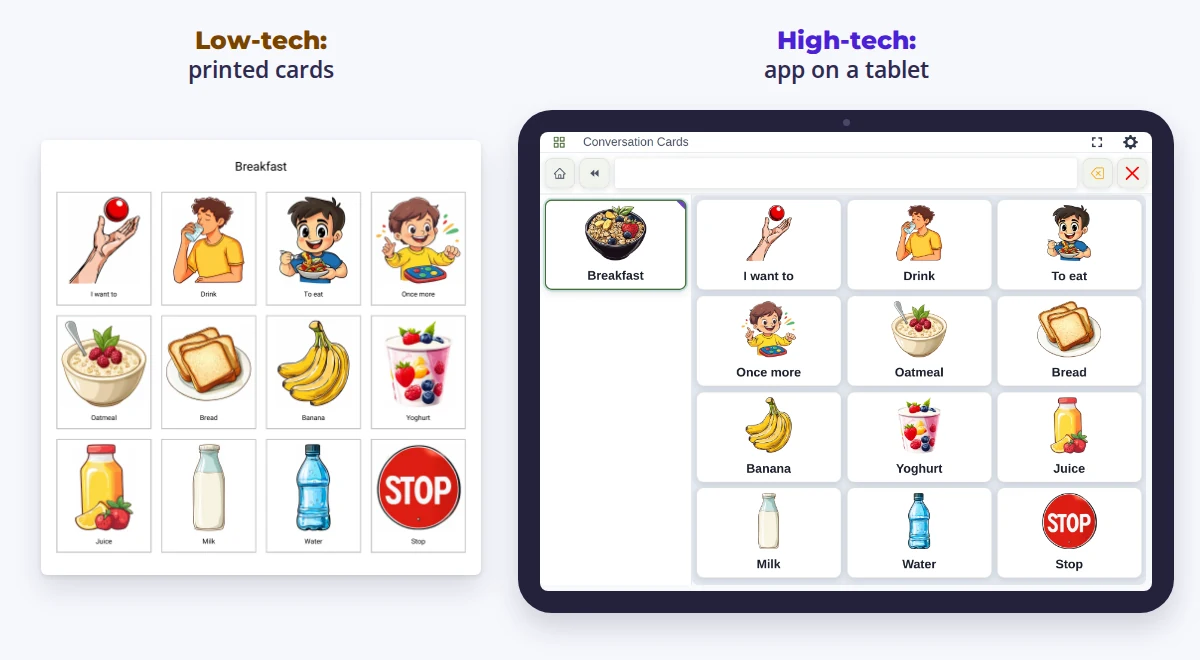
- Simple, no batteries. Real objects (a cup means "drink"), photos, picture cards, communication boards, symbol books. They're often cheap, need no batteries and can be used in lots of places; laminate paper ones so they stand up to water.
- Digital. A phone, a tablet or a dedicated device with an AAC app. Your child touches a picture — and the device says the word. It can hold lots of words.
A simple board is enough to start today. Our guide "A first communication board in one evening" shows how to make one.
What PECS is
PECS (the Picture Exchange Communication System) is a specific method. It was developed by Andy Bondy and Lori Frost in 1985. It has six phases: the child learns to hand a picture to an adult to get something, then to choose between pictures, build sentences, answer questions and comment.
People often call any picture cards "PECS". But cards are a tool, while PECS is its own way of teaching, with its own rules. If you're interested in this method in particular, talk it through with a specialist who uses it.
A toolkit, not a ladder
People often think you have to go in order: objects first, then photos, then symbols, and a tablet "some day later". But AAC researchers Romski and Sevcik call a fixed order of symbol types — from objects to photos and drawings to written words — a myth. And there's no rule that a tablet has to wait until later. Many families mix things: gestures in play, a laminated board in the bath and on walks, a tablet at home and at therapy.
How to choose where to start
- Notice what your child already does. Do they point? Lead you by the hand? Bring you things? Start from what already works and add to it.
- Think about where they most want to say something. A laminated board suits bath time and walks; at the table, a board and a tablet both work.
- Look at their hands. If touching a small picture accurately is hard, other ways of choosing are worth considering. Our guide "How a child picks a picture" covers them.
- Start simple. A paper board or a free app is enough to try it out. A dedicated device is best chosen together with a specialist.
Questions parents ask
Which is better, cards or a tablet?
There isn't one "better". Paper never runs out of battery, and a laminated board doesn't mind water. A tablet speaks aloud and holds more words. Many families have both.
Can we mix gestures and cards?
Yes. Your child uses whatever is easiest at that moment. What matters is that adults respond to every way they communicate.
Do we have to do PECS before moving to a tablet?
There's no required order. PECS is one method, not a compulsory first step. What suits your child is best decided together with a specialist.
My child already says a few words. Why gestures or cards?
To say more than their words allow. They add to speech rather than replace it. Why this doesn't hold speech back is the subject of "Will AAC stop my child from talking?"
Series “AAC: first steps” — part 3 of 8. Previous: Will AAC stop my child from talking? Next: How a child picks a picture: touch, switch, eye gaze. All parts.
How EYA helps
- Picture-card board — A grid of picture cards in folders; a tap speaks the card and adds it to a sentence the child can say or send.
- Print cards to PDF — Export chosen cards as printable sheets for device-free sessions.
- Works offline — The child's board is stored on the device and works with no network; changes sync on reconnect.
References
- What is AAC? — Communication Matters (UK AAC charity)
- Augmentative and Alternative Communication — ASHA Practice Portal
- About AAC — ISAAC (International Society for Augmentative and Alternative Communication)
- What is PECS? — Pyramid Educational Consultants (Bondy & Frost, originators of PECS)
- What is Makaton? — The Makaton Charity
- Romski & Sevcik (2005). Augmentative communication and early intervention: myths and realities. Infants & Young Children 18(3):174–185