
How to tell your child's teacher about their AAC
A teacher spends many hours with your child but may not yet know how they "talk". A short conversation and one page about how your child communicates can help them understand your child sooner. Here's what to share and how to set it out.
What to share
- How your child says yes and no. A nod, a sound, a look, a gesture, a card — whatever they use.
- What they communicate with, and where it is. The board, the tablet, the paper backup. Ask for it to stay with your child all day — in lessons, at break, at lunch, in PE. Mention where the tablet can be charged and where the paper board is for when it runs flat.
- Time to answer. Many children who use AAC need more time to answer. Ask the teacher to pause after a question, and not to guess, finish sentences or answer for your child.
- To talk to your child directly, not to the adult next to them or a classmate.
- To model words on their board. With your child's permission, the teacher can point to one or two words on the board while speaking to show how those words are used. "Show it yourself" explains how.
- Not only requests. The board isn't just for "give me" and "I want". Your child can comment, joke, ask and disagree. More in "More than asking".
If your child uses signals a stranger could easily miss, write a short "dictionary": what your child does, what it means, how to respond. For example, if turning their head away means "no" or "enough" for your child, write: "Ask whether they need a break."
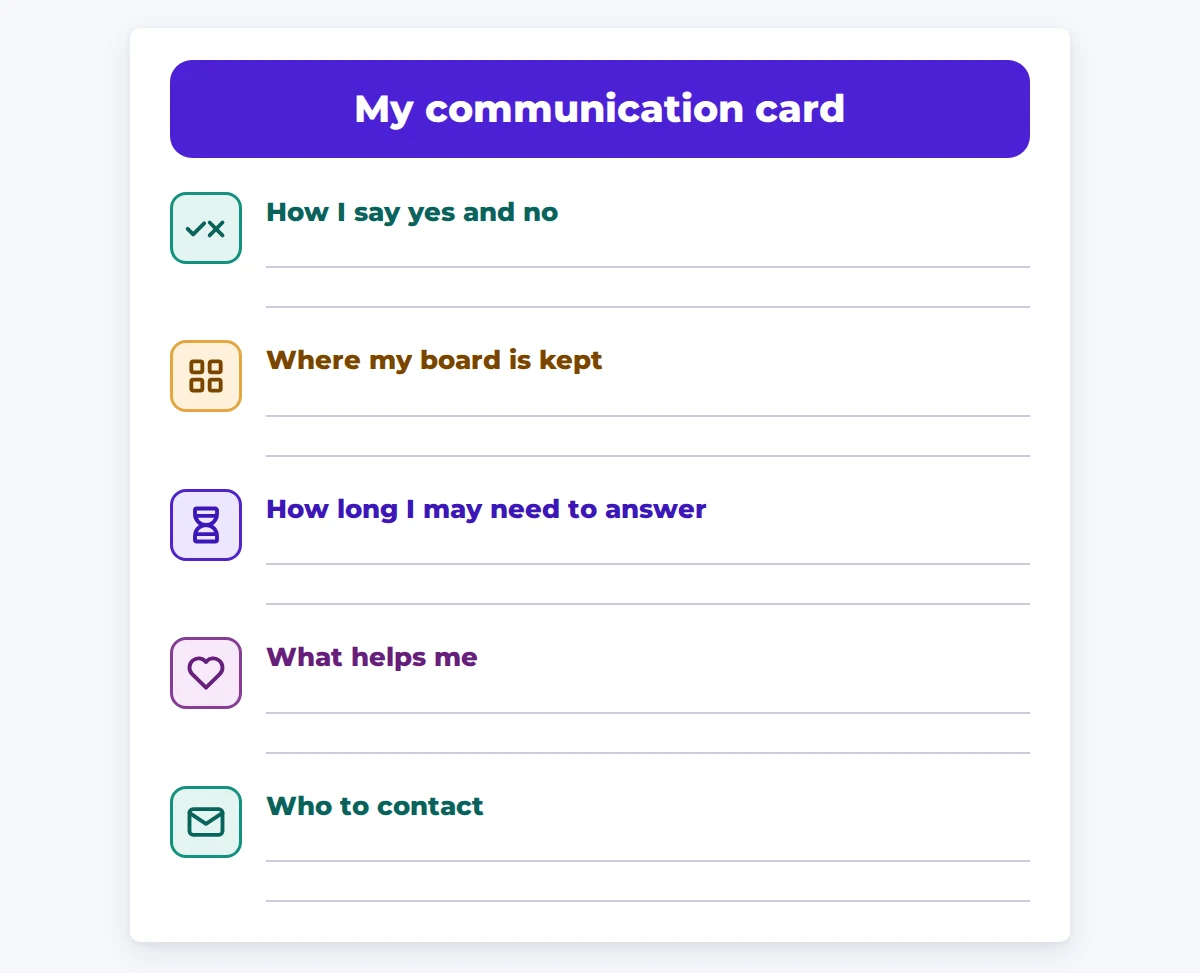
A one-page template
Write it in your child's voice and, where you can, put it together with them. Share only what you and your child are comfortable sharing: you do not have to include a diagnosis on this communication page.
- My name is … I love …
- I say "yes" like this: … and "no" like this: …
- I communicate with: … My board is kept: …
- When I … it means … You can …
- It helps when you: wait for my answer …, show words on my board …
- I find it hard when: …
- If something isn't clear, contact: … (name, phone)
How to hand it over
- If possible, arrange a short meeting. This could be before term starts or during the first few weeks.
- Demonstrate how the board works. Invite the teacher to find a few words on it.
- Leave the page. One for the teacher, and a copy for the other adults who work with your child.
- Agree how to stay in touch. A notebook or messages — whatever suits you both for sharing news: new words, what worked, what didn't.
In EYA you can choose the cards you need and save them as a PDF to print — so the teacher can have a copy too, for example.
Questions parents ask
Do I have to tell the teacher the diagnosis?
That's up to you. To communicate with your child in class, the teacher mainly needs to know how your child "talks" and how to help.
The teacher says there's no time to model words on the board. What then?
Suggest starting with one or two relevant words at a convenient moment, such as "more", "help" or "finished". The teacher can gradually build modelling into familiar classroom routines.
How often should I update the page?
Whenever something important changes: new words, a new way of saying yes or no, new adults in your child's day.
Can classmates see the board?
Yes, if you and your child are happy with that. Show the class briefly how the board works — it can make it easier for classmates to talk with your child.
Series “AAC: first steps” — see also: all parts.
How EYA helps
- Picture-card board — A grid of picture cards in folders; a tap speaks the card and adds it to a sentence the child can say or send.
- Print cards to PDF — Export chosen cards as printable sheets for device-free sessions.